BLOGGER TEMPLATES AND TWITTER BACKGROUNDS
Showing posts with label Brazil. Show all posts

Wednesday, October 6, 2010

Laugh of the Day #25

It's not often something from from my second homeland of Brazil pops up in my reader, but I found this pretty amusing.  Remember when people joked about Jesse Ventura and Arnold Schwarzenegger's candidacies?  (As well as Reagan a generation earlier...)

Amusingly, the newest Deputado in the Brazilian congress is an actual clown.  Some campaign ads:


Some of the video's best lines:

"If you guys don't vote for me, I'm going to die."

"What does a Deputado do?  In reality, I have no idea.  Vote for me and I'll get back to you on that one."

"I will really be doing... um...the life of our Brazil... um...our lives...our moment... our thing..."

Plenty lost in translation, but still amusing.

Thursday, July 15, 2010

Embarrassing Things That Make Me Cry #4

Brazil Next?

In light of Argentina’s decision to endorse marriage equality with public support over 70%, I’ve been thinking a lot about the future of South America.

argentina-marriage-equality

Although I earned a minor in Latin American Studies, I haven’t kept up much on the politics. That said, I came across a video that got me thinking about my mission. I had never thought about it in terms of sexuality, but Brazil is truly the most beautifully diverse place I’ve ever known.

If there’s one thing you need to know about Brazil is that it has a tri-racial culture. In overly simple terms, it is the embodiment of three continents in one—the European settlers, the African slaves (easily outnumbering the slaves imported to what became the US), and the Native Americans.

Although racism does exist, the ideal of coexistence and coalescence of these three cultures over the course of 500 years has arguably been an ideal much longer than the melting pot idea in the US. Having lived in Brazil and Chile, I found that a major difference between the two cultures is the role of race.

brazil-gay-rally Chilean natives Americans are almost treated as a subculture while Brazilians tend to recognize the natives cultures as a significant (and living) part of the past. I think this type of awareness makes the idea of homosexuality much more understandable as there is an innate sense of diversity and acceptance thereof built into the culture. I would argue that to a limited extent this is what drove the Argentine debate culminating in equality.

Seeing this video (which brought tears to my eyes having served an LDS mission in Brazil) and reading that the level of support in Brazil is at a similar level to that of Argentina on Queerty, lead me to believe that equality in my second homeland may be much closer than I’d thought.

Tuesday, June 29, 2010

(Un)Righteous Dominion

Our chastisement was nothing new. The process of taking nineteen year-old boys and women in their early twenties and turning them into missionaries often entailed this type of confrontation. Arguably the single most important rite of passage in the life of Mormon men and women into adulthood, the religious mission has become a science of sorts. Teachers and leaders had speeches prepared to humble us in order to take on the huge responsibilities awaiting us. No one in the world has much reason to trust the average nineteen year-old with finances let alone the proverbial keys to salvation.

It wasn't long before we learned the rigors of the CTM (Center for Training Missionaries)—in a crude manner of speaking it was spiritual boot camp. Ideally, the experience was meant to break young men of their immature habits to prepare them to enter the "Army of God." In many ways, the experience was a success in that sense.

Army of Helaman

That said, more trivial matters than coming of age dominated our way of life in the secluded six-story building. Settling into the routine of the CTM there were a few lessons that came quickly to the intuitive observer. In my first year of college, I'd been trained to examine the world in a set of power relationships and this religious center was no exception.

One person in the entire center wielded an immense amount of power and it didn't take long to figure out. Elders and Sisters would go out of their way to be nice, often begging and pleading, reaching a new level of brown-nosing in the course of their time there. Contrary to what you might be inclined to believe, it was not the President of the CTM, but rather the mail lady.

Brown_Nose

Imagine hundreds of teenage boys thousands of miles from home (many for the first time). On a whim, Sister de Paula could devastate a young man or woman by electing not to pass on a letter from mom or a package from grandpa. Although, I seriously doubt she would have done anything like that (contemplated, yes; actually done, no), many of the missionaries acted as though a syrupy sweet compliment or a piece of candy would somehow get them more mail. As internet access was forbidden in the confines of the CTM and limited to a single hour outside of the CTM grounds, a distinct form of cabin fever infiltrated the minds of missionaries slowly but surely.

In our district, no missionary was more consumed by the seductive power of the mail than Elder Carter who forced his companion to spend far too many of their breaks buttering up Sister de Paula. The usual barrage of compliments and questions she’d heard from any number of homesick or love sick missionaries spurted from Carter’s mouth as he sidled up to her in her office:

“Are these your grandkids? They’re so cute.”
“You have such a lovely voice. Can I join your choir?”
“You and Brother de Paula look so in love. How did you two meet?”
“Could you use some help sorting the mail?”
“What time does it generally arrive?”

Sister de Paula and Sister Ballenger

Without a doubt, she realized that he was one of many young missionaries missing his mother and hoping to find a surrogate somewhere. de Paula didn’t get annoyed at this stream of boys latching onto her as some women might. She welcomed the sentiment, but put him in place.

“Really. I don’t need the help. This is my responsibility and yours is to study and prepare to be a good missionary.”

Elder Laramie smirked and recounted the story to the rest of us when he was out of earshot. Everyone experienced the siren’s call whether that be in the form of homesickness or relationship detachment from that girl (or boy) friend back home. Later that week, during a group study session, we all admitted out catalogue of homesicknesses.

Tuesday, June 22, 2010

Spiritual Match

Making it through the first week of classes at the Center for Training Missionaries, we found ourselves preparing for our first Sunday in Brazil.  Informed by the experiences of missionaries who were our seniors at the CTM, we knew what this day meant for our newly-formed missionary family: one of us would be selected as District Leader. 

Needless to say, a great deal of speculation preceded the decision.  In the few days that we’d known each other, we’d developed a good understanding not only of each other’s personalities, but also the group dynamic. 

Elder Clark and Elder Laramie

“I know Carter is really gunning for DL, but I don’t think I could handle that,” Sister Willis said privately on the way to class. 

Lancey, Ballenger, and I all agreed without a word.  In the few days we’d been together, we noticed a few quirks—his ultra-conservative sense of humor, his devotion to the stringent study schedule, an almost-competitive sense of spirituality.  Perhaps that was the road we were all going down, but he was unbearable to everyone but the most good natured in the district—his patient companion, Elder Laramie, and  Elder Rockefeller who you simply could not be offended even if you were to make fun of his mother.

“We all know Sister Ballenger would make the best District Leader,” I joked.

“Yeah,” Lancey said, “Too bad sisters can’t be District Leaders.” 

We all chuckled and made our way to the sacrament meeting that morning just in time to take the last four seats at the back.  The Branch President and his counselors made their way over to greet us briefly before the meeting began. 

“Elders, Sisters, I’m President Williams.  These are Brothers de Paula and Cruz, the counselors for the branch.  I hope you’re ready for interviews after church today.  We’re all looking forward to meeting you.”

With that, we sat in our seats prepared for the three hours ahead of us.  A sacrament meeting of testimonies and introductions was quickly followed by a Sunday school lesson and another hour separating the priesthood holders from the sisters.  It was one of the more familiar aspects of the whole experience in Brazil—one of the few things that would go unchanged from our time as missionaries and as regular members of the church—the same set of lessons happened to be given around the world any given Sunday. 

President Williams

“Welcome, District 37-A,” President Williams said, “We’re glad to have you here and would like to spend the next hour or so getting to know you as a presidency.  If you’ll all remain here, we’ll meet with you one-on-one.  We’ll have similar interviews at the middle and end of your stay.  Also, I’ll be making our decision on who will be District Leader in your time here at the CTM.  Can I have some volunteers to start off the interview process?”

Elder Carter’s hand shot up like a drowning man reaching for air  Sister Willis and Sister Bangerter also volunteered, sharing a look with each other and with me over Carter’s predictability in this situation.  The three of them left made their way out of the room as the rest of us sat around discussing our meetings and the decision to be made.  There was an interesting dynamic—a rolling wave of flattery as we suggested why each of the guys in the room would make a great leader.  When my turn came—“Elder GMB is just so level-headed and likeable”—I blushed a little before Elder Frazier moved on to Elder Laramie, “You know, you’re probably the most patient.  Who else could handle being Carter’s comp?”

We all laughed for a moment and our conversation devolved into jokes at each other’s expense—my glasses, Sis. Ballenger’s height, Lancey’s acne.  No one was offended because no one was safe, but we soon quieted down out of guilt.

“Next,” President Williams called from the doorway, returning with Sister Ballenger.  “You, Elder GMB.”
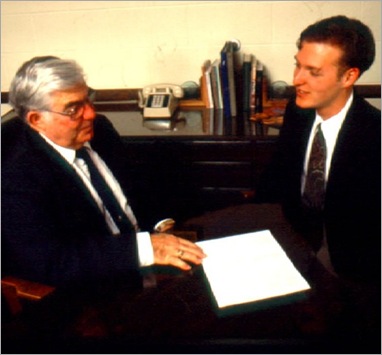
President Williams and me

I made my way to the next room lit only by the frosted glass.  Two folding chairs stood in front of a whiteboard angled towards each other in a 135 degree angle.  It was the same setup I’d experienced since I was eight years old.  Now I realize that each detail of this ritual of interviews, though not necessarily holding a specific meaning, spoke to the rigidity of the culture in which I lived.  Predictably, he asked me to pray, I selected my words purposefully so as to prove myself spiritual and sincere, he gave me a speech on how important my calling as a missionary:

“Heavenly Father has been preparing you for this moment long before you were born.  There are souls out there waiting to receive his Gospel through you and it’s in your time here that you must steel yourself for the long journey ahead.”  What followed was a short explanation of how I’d gotten to where I was at that point in my life.

“Well, I’ve always planned on doing this.  Doing what I was supposed to do.  I always expected myself to end up on a mission and then when it got close, it just felt right.  I just felt prepared.  When I opened up that envelope and got through the initial surprise, I knew it was what I was supposed to do.”

“That’s a beautiful story.  It’s through the small and simple things like those feelings that great things come to pass and great boys grow into great men.”

We concluded with a little discussion of life back in the states.  He was a lawyer for the Church and asked to use his Portuguese skills (acquired on a mission some fifteen years ago).  His wife and daughters accompanied him, seeing as an opportunity to enrich their lives culturally while serving the Lord.

I shared my story and was surprised by how much was school related.  “I’m the middle of three boys.  I want to be a college professor and teach literature, but l think journalism seems more practical.”

“You look into journalism.  The world needs more independent journalists.”

And with that, we closed with a prayer so he could interview the next missionary.  I wasn’t sure what to make of that last comment.  I’d spent a good deal of my life navigating the hostile roads set out for a liberal Mormon and it was clear he wasn’t particularly friendly to those views.

As we returned to the other room where the missionaries waited, I noted the volume had increased considerably.

Too Loud “Quiet down! This is a sacred space,” President Williams interjected as a few of the Elders scuttled back into their chairs.  “You are missionaries not middle schoolers.”  He left the room for a moment to tell his counselors he would be supervising us. 

In an awkward silence, we contemplated the bootcamp-like conditions.  We couldn’t handle being 100% spiritual, 100% reverent all of the time.  If this is what being a missionary meant, I don’t think any of us were prepared for the next two years.

Finally, once all the interviews were finished, President Williams convened his counselors to discuss their leadership decision.  In the meantime, Elder Frazier apologized for telling stories about the police catching him making out with his prom date on the roof of a church and Elder Laramie for the Chapelle Show impressions. 

“I must say we’re more than disappointed in your behavior.  I know that this is a time for growth as many of you have left your families for the first time less than a week ago.  You have some powerful lessons awaiting you and I hope this is the first:  you are now adults.  You will be expected to act as such.  As Paul instructed the Corintians, ‘When I was a child, I spake as a child, I understood as a child, I thought as a child: but when I became a man, I put away childish things.’

“One Elder here has shown a great deal of maturity and devotion in choosing to serve a mission.  He’s proved himself diligent according to your teachers and in his interview with the branch leaders.  We ask that each of you support and sustain Elder Laramie in his new calling as District Leader.”

Monday, May 17, 2010

View from a Window

The Wanderings and Delusions of a Gay Mormon Missionary

I’ve had to slow down the blog a bit as I gear up for a big project this week (and due to a certain distraction).

Instead of a regular post, I present to you a panoramic photo from the area of the CTM. This is roughly what the neighborhood looked like from the windows there.

Wednesday, May 12, 2010

Sonriso, Part 7

“Smile-- it's the second best thing you can do with your lips.”
~Author Unknown

It was a dream.

Every facet of the date seemed to go just right.

The couple started out at a tiny ice cream shop. Ice cream was one thing about which they were both highly opinionated, having spent a great deal of time in South America between the two. Ice cream took them back to memories of sorveterias, of Brazil, of Argentina, of missions, of disappointments, of fears, of joys, and of the idea that someday they could return and share that with someone—not ruling out the possibility of each other being in that supposed future.

Ben's Cookies

They continued their chat not perceiving anything around them. A tiny sphere of intimacy and normalcy as the world whizzed by questioning their decision to walk around eating ice cream on a blustery January day. Walking around engaged with the whimsy of nostalgia was enough to keep them from noticing their reddening noses and the subtle shrinking of their smiles to conserve heat.

As was customary, they quickly moved on to the second part of the date at the planetarium. Science wasn’t really their main focus in life, but the complexities of the universe still demanded more curiosity than anything with the exception of human emotion.

Clark Planetarium

Both in their mid-twenties, the experience returned them to the lessons of a decade ago in middle school science as the relearned concepts of density, the nature of light, and the age of the universe. At each exhibit, a sense of competition emerged as they quizzed each other on basic knowledge, covering up information and asking pointed questions:

“What is the primary reason the earth has seasons?”
“Explain the aurora borealis.”
“Glass, rubber, and plastic have what in common?”
“A nebula consists of what?”

The nerdy flirtation was balanced out by a great deal of nostalgia for middle school and for friends neither of them had really thought about for some time. Seeing the kids around them only approximated them to those awkward days and memories of unsurity and ostracization as well as coming of age. They were comfortable in their skins now and able to let go in public, taking silly pictures of each other landing on the moon and forecasting the weather.

Following a walk through a feathery snow, they contemplated what to do next. A mile later, waist-deep in conversation of dreams for the future, inspiration hit and left a smile across both of their faces. As the temple in downtown Salt Lake came into view, it seemed the obvious finale to a good night.

temple-square-christmas-lights-

It was like sunset on earth. Brilliant points of pink, white, and orange painted across the sky and the trees and the pools of water as the breeze tugged at their surface. The sister missionaries skirted around the perimeter getting ready to go home weary after a day of proselyting. As they walked in silence taking in their surroundings, they found themselves arm in arm blushing a little.

Quietly, they made their way to the doorstep where it all began. The usual—but sincere—“I had a great night,” bashful smiles, and glances into each other eyes, and finally a kiss—not perfect, slightly awkward, and deliberate enough to remain unforgettable—two smiles becoming one for just one moment.

***

In a way, the date was every cliché in the book. Everything I’d imagined and wanted to have before I realized I was gay. I wanted a cute day date. I wanted ice cream and adventures. I wanted to walk hand in hand on temple grounds. It was better than that clichéd dream I'd desired for so long. Fearlessly, Evan was able to make those unspoken dreams—impossibly idealized and conditioned upon me—come true or at least made possible somehow. He was able to fix that piece of me that said “You’ll never have what you really want.”

End, Part 7.

Monday, May 10, 2010

Mundane Redemption

CTM life could definitely be compared to high school in a lot of senses. I imagine it was a lot like boarding school, although 95% of us never had that experience. All of us were miles from our families and stuck with hundreds of others in similar circumstances. The entire facility was barred up with iron fences painted tree bark brown so as to not let people in or out and everyone was tied to someone.

Lindley and GMB

The idea of solitude would soon become a foreign concept (with the exception of say a bathroom stall). For those eight weeks, you were stuck first, with your companion; and second, with your district. It took some adjusting, but Elder Lindley was seldom out of sight and District 37-A seldom didn’t account for the whereabouts of each of its members. Following the meeting in which we were all assembled for the first time, we were guided to the cafeteria by an instructor who reminded us in excellent English with only a slight Brazilian accent, “Wash your hands before every meal. You are welcome to eat as much as you like here, but don’t forget to swipe your card as you come in. Do not forget that Friday is pizza day. It will be a taste from home.”

The Sisters cut in line as they were instructed as the Elders waited. “I don’t think I’ll ever get used to that being fair,” Elder Laramie whispered to the other Elders. “I’m 6th of 6 kids, and we all had to fight for our food. It didn’t matter if we were guys or girls.” I gave a reserved chuckle. Considering myself a feminist, I was cautious about the implications of the statement.
We all made our way into the lunchroom eventually. It was a somewhat sterile environment akin to a hospital cafeteria with tile floors in neutral grays and blues and Plexiglas windows. Three times a day you’d grab a plastic tray and make your way through walls of stainless steel shelves pulling out the entrees of your choice, rolls that reminded you of sea shells in shape and often in stiffness, fruits, yogurts, juices, and desserts. Later I’d spot many missionaries examining the food as I did that first week as they were arriving and I became one of the more seasoned missionaries.

Everyone I’d asked about Brazil had said to me, “Prepare for beans and rice every day for two years,” and suddenly there were the beans and rice staring me in the face. The combination seemed a bit odd. In a silent pact, all of us took a scoop of steamed white rice and a scoop of brown beans in our bowls to give it a try. We passed each other smirks, amused by the experience we were suddenly sharing with each other—the tie of being a Americans in Brazil that would be lost on many of us in the weeks and years to come, unfortunately.

The ten of us congregated around a string of tables each sitting next to our assigned companions. We’d gathered in our limited discussion the basics on each other—that Koontz had left a girlfriend at BYU, that Laramie had a twin brother in Portugal on a mission there, that Sister Willis had been planning on a mission since she was a little girl. Although we had our missions and our common culture of being born and raised in the church, it was clear (for better or worse) that we would not end up together as a group had we not been assigned—or called—to become friends.

CTM Cafeteria

Reserved, I sat back most of the day and made observations. I didn’t really have anything to share that I found noteworthy. The farthest I’d been from Utah was Montana. I’d spent all of my time in school or with friends. I grew up in a suburb straddling city and country, past and present. Normal, boring, and un-noteworthy. Lindley was his class president and an avid wakeboarder. Carter had siblings adopted from three different continents. Ballenger sounded like she’d miss football games at the U as much or more than her family. Rockefeller played soccer for ten straight years.

The feeling crept up, as I got to know these people, that I was somehow undefined. The reserved one in the corner from high school. Smart and able to write, but undefined because I did not share out of fear or shame for the mistakes that were visible to me. Angry with my quiet nature, with my excess weight, with my lack of confidence entering social situations, I didn’t want to be me at that point in my life.

Collectively, though, the district didn’t have those problems. We balanced each other out in our eccentricities and our backgrounds (similar as they initially seemed). Being “un-noteworthy” became less and less of a reality as time pressed onward. To that point, I never would have thought my life interesting (let alone believe I’d blog about it regularly), but with my fellow missionaries in the CTM, I was to gain (in the smallest degree) an understanding that the difference between the mundane and the exotic—reality and story—was not as rigid or boring as I’d once thought.

Monday, May 3, 2010

District 37-A

Elder Hugentobler and Elder Elder Lindley’s prank was a little lost on me. Sure, I was surprised when they popped out from behind the door, but not as much as they were hoping—no scream and only a small jump at that.

“You okay?” Elder Hugentobler asked half in jest. He was a stout guy about 5’10”. His blond hair was short—too short even for clean-cut missionary standards, and his face embodied a potential for innumerous expressions—currently it registered something along the lines of mock remorse.

“Yeah. Sorry, man,” Elder Lindley (who had a more reddish complexion, thin black hair and blue eyes) said. “You’ve got to admit that was pretty funny, though.”

“It’s all good,” I said—unaware that I was already beginning to sway from my somewhat uptight attitude. I might see something like that as an attack or teasing before, but not knowing me and being united as missionaries, I found no ill will in their little prank.

“So where are you from?” Lindley asked.

“Utah. Most boring answer ever. I know,” I shared.

“We both flew in from Boise. We grew up just outside of town and figured out we had a few common friends on the trip down,” Hugentobler (later informally abbreviated “Elder Hugie” and then “Elder H”) explained.

Boise

“Rival high schools and everything,” added Lindley, putting an arm around Hugentobler. “I guess we’re only missing your comp now.”

“—Elder Koontz. I wonder how you’re even supposed to pronounce that one.”

Rather than getting any actual sleep, though we were all dead-tired, we talked to each other from our bunks about our families at home and what it would be like to learn a foreign language in the coming weeks before going out into “Real Brazil.”

Before we’d realized, it was time for the big beginning to the Mormon missionary’s equivalent of boot camp.

All of the newbies—around three dozen of us on that particular day—were rounded up and taken to the gymnasium like something out of a middle school built in the 1950s, except the floors and other wood features were noticeably defined in color and tone—a distinct and beautiful mahogany. There was a stage with a green curtain pulled, a podium with 5 chairs along side. To the right of the stage was a simple, upright piano. A woman in her early sixties sat opening her hymn book and reviewing the program. To either side were stacks of chairs off in darkened wings, laying dormant until a larger meeting we could only imagine at that point.

Hogentobler, Lindley, and I took our seats as far back as was possible at that point before the meeting began. Also in attendance were Sister Ballenger, Elder Rockefeller, and Elder Alan.

Ostegars

A white-haired man rose to the podium. “Welcome, Elders and Sisters. I hope you are adjusting to these titles quite well. As you all know, this is the Centro de Treinamento Missionario. I am President Ostegar and this is the lovely Sister Ostegar and you will be in our care here. As President of the CTM, it is my charge to prepare you for missionary life outside of these four walls. I use the word life purposefully because every aspect of your life will be concerned with the work of the Lord for the next two years (or in the case of you Sisters, 18 months)—you will speak and share the Word of God, you will feast upon the Holy Scriptures, and you will depend upon your diligence and faith for the gift of tongues to understand and speak in Portuguese.”

The next half hour consisted of introductions of the rest of the CTM Staff (Vonaldo, the de Paulas and the Oblads), a review of a map of the building, and several tips for our time in the CTM and in Brazil from the Ostegars:

  • “Don’t pet stray dogs.”
  • “For those of you that didn’t not hear the announcement earlier, this section is reserved for the Sister missionaries.”
  • “All of you are encouraged to participate in the CTM Choir led by Sister de Paula. Practice is held each Sunday afternoon.”
  • “Only the CTM-contracted barber is allowed to cut anyone’s hair in your stay. He is here for an hour before breakfast every morning and you must sign up 24 hours in advance.”
  • “Food should remain in the cafeteria. Please get your fill during dinner because it is a long time between the end of dinner and breakfast the next morning.”
  • “Do not buy meat or fruit from street vendors.”
  • “No climbing the trees in the courtyard.”
  • “We practice S.Y.L. to ensure you learn Portuguese. Speak Your Language from the moment you start learning so you can.”
  • “You will be responsible for keeping the CTM clean with weekly service.”
  • “Wash your hands several times each day.”
  • “Keep the Sabbath day holy by reverently studying and resting.”
  • “You’ll be responsible for any broken or lost locks and keys.”
  • “The Sisters will be having their own set of orientation for ‘women’s health issues’ every few weeks.”
  • “Gym time is three times a week. There’s a track, a footsal court, and exercise equipment.”
  • “At lunch you should always eat at least five different colors of food to ensure balance in your diet.”
  • “Do not forget the two names on your nametags—that of your family and that of the Lord.”

Writing Journal

Following this barrage of tips and furious note taking in the notebooks they’d provided us at the beginning of the meeting (I still use mine for writing projects—as evidenced by the picture above), Pres. Ostegar announced, “I will now read your names off as this week’s new districts 37-A, B, and C are formed. You will then meet with our staff for additional orientation. 37-A, your instructors will be Irmão dos Santos and Irmão Andre please come to the front of the hall as I call your companionships. “Elder GMB and Elder Lindley.”

We made our way up eagerly, only slightly phased by the realization of constant coupling we were now facing.

“Elder Hugentobler and Elder Koontz.”

A blond, blue-eyed 6’3” missionary in the back of the room made his way to the front of the room having arrived on a delayed flight from Wisconsin.

“Elder Carter and Elder Laramie.”

Carter was beaming, though still awkward, as he rushed over. Laramie, on the other hand, would be more aptly described as “jolly.” He also took a more metered stride not because he was shorter or Latino. He simply emanated a mellow presence.

“Elder Rockefeller and Elder Frazier.”

As they made their way to the front, I noted that Frazier was the Laurel to Rockefeller’s Hardy. He was stronger, taller, and together. The kind of support Rockefeller needed to keep him grounded in reality.

“And finally, Sister Willis and Sister Ballenger.”

While Sister Ballenger was sporty as could be, Sister Willis gave off a very different vibe—something along the lines of “Valley Girl” on first read: blond, volleyball player’s build, tan.

For the next 2 months we had our own sort of Breakfast Club… we’d eat, learn, and sleep together—same rooms, different beds, the Sisters on a different floor—preparing for our own big adventures outside of those four walls.

CTM District

Monday, April 26, 2010

São Paulo Vivo

The Wanderings and Delusions of a Gay Mormon Missionary

Through the crowd, a small herd of Mormon missionaries came into view—“herd” being the appropriate metaphor because we all had a collective semblance of terror, arriving in a new country mostly unfamiliar with the language and culture. The small man who had shouted “Welcome to the jungle!” as we made it through customs approached and explained in his broken English, “Stay with me. Soon we will go to the CTM (pronounced Say-Tay-Emmy) in the van.”

Sao Paulo airport

We all stood there with our mounds of luggage and taking in the atmosphere of the airport. This hub of international travel brought together our group of missionaries, some nuns, well-dressed businessmen and women, Charlie Brown, Jr. (a popular, nationally-recognized rock band), and a hoard of their fans. In that moment, I realized that my life as a sheltered, rural Utah boy would not continue. Everything had been so ordinary, expected, and usual to me at that point and now (though my life was still mapped out for me in a way), and now that was all going to change. Everyone has their growing up moment—the moment in which you realize you’re not really a kid anymore and that you’re meant for bigger and better things. That moment came as I hoisted my bags over my shoulders and made my way to the van.

It was a march into epiphany as we walked from the cement terminal to the bay of vans and taxis. The brilliance of the Brazilian sun became more and more apparent as the train of gringo missionaries cautiously rolled along. It peeked through the tinted windows on the doors clearly labeled “Saida” and appeared almost white as we squinted to see beyond the shade of the terminal of vans.

Excited and loaded up, we made our way into the vans—the drivers eagerly awaiting a journey they’d clearly made several times before. The more eager missionaries tried using their scant Portuguese skills to ask their names and explain that they were missionaries, to the amusement of the Brazilians watching out for us.

sao-paulo-1

Skyscrapers of glass and steel, insular slums, smatterings of urban litter and graffiti art of Che Guevara, Bob Marley, and George W. Bush, the enormous concrete river of black sewage. Brilliant red and blue banners signaled the beginning of an election season reminding me that 2004’s US election was just around the corner. Groups of twenty-somethings in shirts with golden yellow lettering “SERRA” stood on street corners shouting slogans.

The city was alive, as I’d had a glimpse into the passion São Paulo and Brazil had to offer. I suppose middle school civics had twisted me into thinking that American politics was superior somehow, but suddenly I noted that it was nice for people to believe in something enough to take to the streets and show it, and as I looked around at the other missionaries with their faces pressed to the glass in their white shirts and ties, I realized that we had a lot in common with our Brazilian brothers and sisters.

***

We arrived an hour later at the CTM exhausted from travel, anticipation, and the sewage river’s overpowering smell (I’d describe in terms of smells emanating from outhouses, highway construction, and the sulfurous hot pots of Yellowstone). The Centro de Treinamento Misionario (CTM) is a center for training all Mormon missionaries that serve in Brazil and perhaps the largest conglomeration of American citizens in all of Latin America, which is why the first thing you notice as you arrive are the tall fences lined with sharp tips and a booth occupied by a severe-looking guard. The thought of prison immediately came to mind—a funny side note in the moment.

Again, we filed our way in the gates before closing them behind us and offering our Thank Yous to the driver without thought that they might go lost on his Portuguese ears. Unexpectedly, as I stumbled through the gate with my clutter of luggage, I spotted a familiar face.

Wednesdays CTM

“GMB. E ai, cara?”

It was Jim Toone. As I later learned, he’d been here a month and tried to impress me with his knowledge of Brazilian slang. We grew up 2 miles from each other and went to school together, though we’d hardly spoken. He was a snowboarder I’d always considered a slacker and wondered if these two years would change him.

“Nice to see you… a continent away. I wasn’t really expecting any familiar faces for a couple of years.”

Conversation was left to a minimum because we didn’t have much to talk about, and I had a lot to think about.

A few instructors who greeted us at the gate gave us some helpful instructions in English and helped us to our rooms.

“Elder Gay Mormon Boy” I heard called from across the courtyard.

“Yes,” I said as I made my way.

“You’re in District 37-D and your companion is Lindley. Follow Irmão Henrique to the fourth floor with your things. Oh, and don’t forget your blue dot.” And with that, he removed a sticker from his clip board placed it on my name tag, and pointed me in the direction of Irmão Henrique.

“There are only two times you use this elevator,” Irmão Henrique pointed out the group sternly as a small group of four or five of us rode up the shaft with our luggage. “When you arrive and when you go.”

We turned right outside of the elevator as he grabbed a stray bag of mine. Thankfully, he instructed us all to take a good nap and be ready for orientation in a few hours. Eager to throw my bags down and pass out on my bed, I thanked Irmão Henrique, then taking a deep breath, I opened the door. It was what you’d imagine for a dorm. Three bunk beds and three desks all in brown and white tones. I rolled my suitcases in, taking in the coolness of the open window and the tile floor. As I turned around to shut the door, two missionaries popped out from behind it. “You must be Elder GMB,” they shouted as I jerked away in shock.

Monday, April 19, 2010

“Welcome to the Jungle!”

The Wanderings and Delusions of a Gay Mormon Missionary

Aerial view of pristine Amazon Rainforest or jungle, Brazil

I’d put my life on hold. I’d taken a leave of absence from school, put my scholarships on hold, left my job, and—moments earlier—said goodbye to my family. Two years later, I’d return to that same airport and see them almost as I’d left them: some slightly taller and wider but mostly just the same.

I, on the other hand, wouldn’t be the same person, arriving barely recognizable—physically fit, able to handle stress constructively, goal-driven, etc. Now that you know the ending of this series, the emphasis is conveniently placed on the how (the process and story) rather than the what (the outcome).

All of the preparation I’d made—attending missionary preparation classes and such—seemed slightly off. Working in the hypothetical and role-playing fundamentally discounted individual nature. No amount of practice could prepare me for the human interactions ahead. The first of these interactions, with Elder Rockefeller, a fellow missionary, was a clear indicator.

Neither of us were accustomed to our hours-old missionary existence. No longer being called by our first names, not being allowed to hug people of the opposite sex, not being allowed to watch television or movies, and now always having another missionary at your side felt a lot like walking in shoes of two different sizes. The rhythm of conversation was thrown off.

“So, you’re headed to Brazil, too?” I asked after our awkward introductions.

“Yup,” he said distinctly. Rockefeller, from that moment, came off as a combination of Goofy and that stoner from the back row of your geometry class. He wasn’t all there, but in an innocent kind of way.

As we talked (finding out we were going to the same area in Brazil), he seemed to have the same cool tone about everything from his memories of high school soccer to the breakup with his girlfriend just a month earlier. He wasn’t worried at all about the next two years of his life. In fact, to him, this adventure to another continent seemed to be just another day of life—an impression I couldn’t really fathom at the moment, especially since I hadn’t considered any aspect of my life particularly special at that point in my life.

Rockefeller Ballenger Carter

The trip became a blur of new faces and stories. A few other missionaries trickled in, but we stuck mostly to the groups we were assigned because we knew we’d be together for a couple of years. We were joined in those moments by Sister Ballenger and Elder Carter who I’d seen with his huge family taking pictures and crying as I entered the airport and as I said goodbye to my own family. He was the oldest in his family to serve a mission, so it was a highly emotional experience. I remember his mother sobbing as he held her with that deer-in-the-headlights open-eyed stare.

At 5’3” Sister Ballenger managed to put some energy into the demanding and slightly terrifying journey to another continent. She was the youngest of four kids, all of whom served missions. In conversation, it seemed that the things she’s miss the most while in Brazil would be U of U football and running marathons. She was refreshingly different and appealing in that she wasn’t just another 19 year-old boy mandated to go and serve. She was here by choice and a few years our senior.

Our conversations continue on our flight in which I sat sandwiched between Ballenger and Carter, the layover in Dallas, and then our flight to Brazil.

“I can’t believe it’s finally happening,” Sister Ballenger gasped, leaning towards me then pulling away realizing her forbidden impulse to hug me. It was a cautionary rule, a barrier to keep missionaries from being tempted by the opposite sex, and we heeded. Ironically, temptation from the opposite sex, I came to realize later, would remain a null factor in my experience.

The journey entering its tenth hour, Rockefeller, Carter, and Ballenger all drifted off to sleep as the cloak of night was pulled over our path. Unable to sleep, I pulled out a stenopad and started writing as everyone around me, a hodgepodge of races, nationalities, and languages. Regardless of these differences, they all drifted off to sleep—except for me and one other missionary across the aisle and down a row.

Plane to Brazil

We were both writing and I was intrigued. A fresh new journal lay open on his folding tray with a few pages turned like my stenopad with some scrawlings and a pair of letters to Nate and Cole, already on their missions, analyzing the experience I was currently passing through.

Noticing I was also awake, he passed me a note:

“Hey, I’m Elder Alan. Where are you from?”

“Nice to meet you. Elder GMB. I’m from Utah. Boring, I know.”

“I’m from Mesa Arizona.”

“Used to the heat then, I guess?”

“Yeah. I’m not too worried about that. You worried at all?”

“For sure. What if I don’t learn the language? What if I get sick? If there’s one thing I’m good at, It’s worrying.”

Our conversation turned to home and what we’d miss. Of course our families and school, but our nerds got the best of us as NPR programs were added to the list and we spent the rest of the flight recalling memories of Car Talk, Diane Rehm, and Prairie Home Companion across the pages ripped from his journal. Looking back, Elder Alan fits a pattern for me: intelligent, tall, dark, handsome. Were I to run into him today, I’d realize that my fascination with him writing and having a nice smile were more than I understood at the time.

Elder Alan

Light began to penetrate the plane’s tiny windows as the announcements regarding altitude and safely deplaning were read in Portuguese, English, and Spanish. That was the first sign that changes lay ahead for us. Lethargically but deliberately, everyone elbowed their way to their carry-ons and overhead luggage. As the missionaries gathered at the gate, we all seemed to realize the reality: we were here and there was no turning back. In a haze of foreign language and unfamiliar instructions we fumbled through customs, not quite sure what waited for us outside of the airport.

Once through customs of Sao Paulo’s immense metropolitan airport, we heard a loud, accented voice shout “Welcome to the Jungle!” emanating from a dark-haired man no taller than Sister Ballenger.

Popular Posts